
Top 9 electronic signature use cases: How industries sped up document turnaround by 80% with SignNow

Industries using eSignature, from real estate to healthcare, have dramatically accelerated their workflows by replacing manual, paper-based processes with digital signing processes. This shift allowed businesses to sign contracts, finalize agreements, onboard clients, and process paperwork in minutes rather than days, resulting in measurable time and cost savings across every sector that adopted it.
Results at a glance:
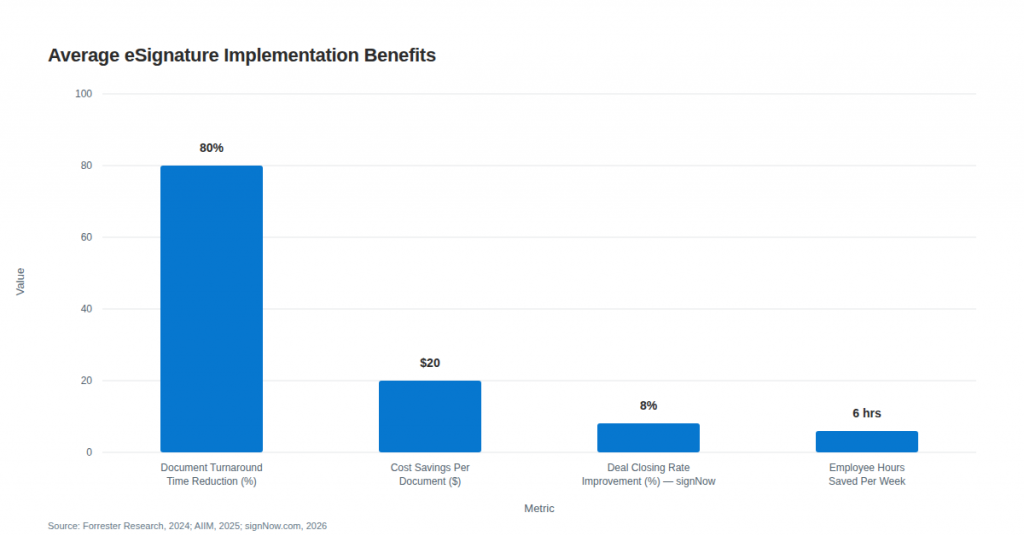
- Organizations reported an average 80% reduction in document turnaround time after adopting electronic signature software
- Implementing e-signatures saved businesses an average of $20 per document in printing, postage, and administrative costs
- The global electronic signature market was projected to reach USD 43.7 billion by 2030, expanding at a CAGR of 26.9% from 2024 to 2030
- SignNow users saved up to 6 hours per week per employee on document signing processes
- SignNow improved deal closing rates by an average of 8% across its customer base
The market growth reflects a structural shift, not a temporary trend. As Gartner noted in 2025, organizations are using AI and machine learning to analyze documents before they’re signed. This technology automates contract reviews, flags missing fields, and routes documents to the right people without manual work. In 2026, this capability had moved from enterprise-only to broadly accessible, making the case for digital document workflows stronger than ever.
In this article, we’ll explore the 9 electronic signature use cases, their transformative benefits, and how they streamline workflows, enhance security, and improve compliance across various sectors. By eliminating paper processes and introducing faster, more efficient approval methods, eSignatures have become a critical tool for modern organizations. We’ll also examine how industries such as finance, healthcare, legal services, and real estate are leveraging electronic signature technology to adapt to evolving regulatory requirements and drive operational success.
The universal paper challenge: Why manual workflows cost you more
Before eSignatures, businesses in every sector faced the same challenges with manual, paper-based processes. These outdated workflows were slow and created significant operational costs, compliance risks, and frustrating experiences for employees and customers alike.
A paper-based approval process is like a relay race, where each team member is in a different city. You need to mail documents from one person to the next, and if anyone is unavailable, the whole process stops. Electronic signatures get everyone on the same track, at the same time.
Paper-based workflows create bottlenecks that slow down business and increase risk. According to AIIM’s 2025 research, manual document handling and handwritten signatures are the top two hurdles in administrative workflows. It’s no surprise, then, that 58% of organizations cited “speeding up and simplifying business processes” as their primary reason for digitizing paper-based operations.
Here are the most common pain points we heard from teams:
- Disconnected systems: Paper documents don’t talk to CRMs, ERPs, or HR tools. This forces staff to re-enter data by hand, which wastes time and leads to errors.
- Compliance risks: Physical documents lack a clear audit trail. This makes it hard to prove who signed what and when, which is a major liability in a dispute or audit.
- Location bottlenecks: Wet signatures require everyone to be in the same room or rely on mail. This can add days or even weeks to a process that should take minutes.
- Security weaknesses: Paper files in a cabinet or sent by fax have no real security. There’s no encryption, no access control, and no way to see who has handled a document.
The table below clearly shows the differences in document workflows teams faced before and after implementing electronic signatures.
| Criteria | Before eSignatures | After eSignatures |
| Contract signing cycle | 5–14 days for multi-party document completion | Same-day or next-day completion |
| Cost | $20+ per document in printing, postage, and storage | Near-zero per-document cost |
| Audit trail | No tamper-evident audit trail | Full audit trail with IP, timestamp, and signer identity |
| Data entry | Manual data re-entry into business systems | Automated data sync via native integrations |
| Compliance | Compliance dependent on physical storage controls | Compliance is enforced by platform certifications |
These problems did not affect one or two industries — they affected every organization that relied on agreements, consents, or approvals to conduct business. From sales and legal to HR and operations, teams across the board felt the friction of slow, insecure document workflows.
The challenges posed by manual, paper-based processes were not just inconvenient—they were costly, time-consuming, and risky. To address these issues, organizations needed a solution that was not only efficient but also secure, compliant, and adaptable to their unique needs. This is where eSignature platforms like SignNow step in, revolutionizing document workflows with their comprehensive solutions.
The solution: How SignNow digitizes and secures agreement signing processes
SignNow addresses the challenges of paper-based systems by providing a secure, compliant, and easy-to-use platform for legally binding eSignatures. The solution enables businesses to automate their agreement processes, integrate with existing tools, and deliver a consistent signing experience on any device.
Who uses eSignatures?
From individual proprietors to Fortune 500 companies, teams across more than 20 industries use SignNow to automate approvals. The platform provides a consistent signing experience on any device, whether in the office, in the field, or working remotely.
How teams use SignNow
Key features include:
- Workflow automation: Reusable templates, customizable signing order, and bulk sending to streamline repetitive tasks.
- Access from anywhere: Mobile apps for iOS and Android, with offline and kiosk modes available.
- Security and authentication: Advanced data protection and authentication methods to verify recipient identity and protect sensitive documents.
- Seamless integrations: Native integrations with Salesforce, NetSuite, Microsoft 365, and more, plus API access for custom connections.
With an ease-of-setup score of 8.9/10 on G2 and 24/7 live chat support, most teams can deploy SignNow and start streamlining their workflows within days.
Why SignNow
Organizations choose SignNow for its blend of ease of use, transparent pricing, and robust security and compliance. The platform meets key industry standards, including SOC 2 Type II, GDPR, and HIPAA, making it a trusted solution for regulated industries from healthcare to government. All documents are protected with AES-256-bit encryption at rest and TLS 1.2/1.3 encryption in transit.
How it worked
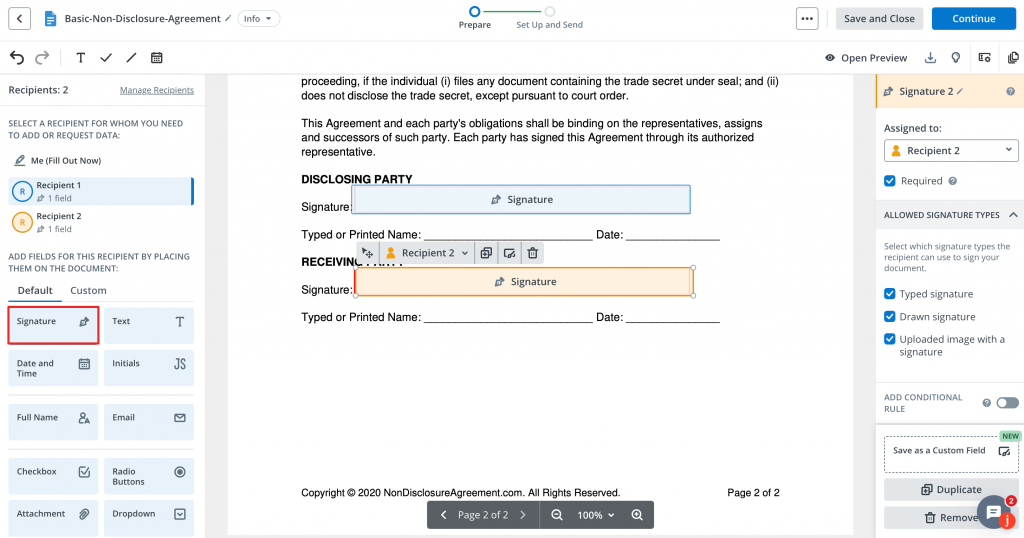
Users upload a document (PDF, Word, HTML, or Excel), add fillable fields using drag-and-drop or automatic field detection, set a signing order, and send the document via email or a shareable signing link. Signers receive a guided experience on any device, complete their fields, and sign — triggering an automatic notification to the sender and updating the audit trail in real time. This flow enabled organizations to significantly accelerate document signing, reducing turnaround times and improving overall workflow efficiency.
SignNow’s G2 score stands at 4.6 / 5 for its intuitiveness, eSigning features, and pricing policy based on over 1,700 user reviews. The platform has also earned an average rating of 4.6/5.0 from over 30,000 reviews across other trusted review platforms, like Capterra, Gartner Peer Insights, and the App Store.
Now, let’s see how organizations across nine different industries improved their document signing workflows using eSignatures with SignNow.
1. Real estate: Closing deals faster, from anywhere
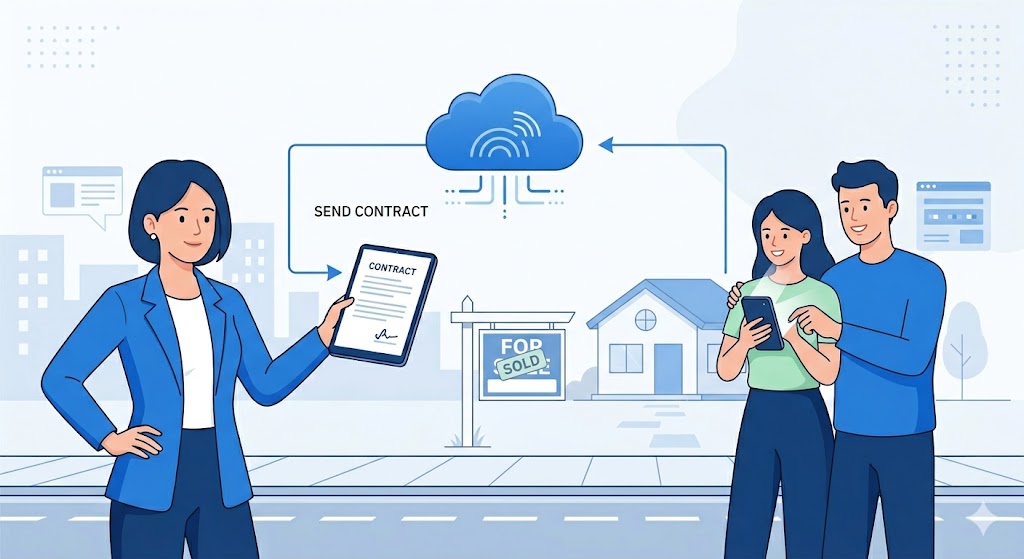
The real estate industry saved significant time by implementing electronic signatures, eliminating the need for in-person meetings for time-sensitive documents such as lease agreements, purchase offers, and closing paperwork. This allowed agents and clients to execute contracts instantly, from anywhere.
The industry challenge
Real estate transactions involve multiple signers — buyers, sellers, agents, and attorneys — often located in different cities. Coordinating in-person signings created delays and put deals at risk. Agents managing a high volume of documents had no way to create, track, or finalize paperwork from the field. According to the 2025 IDC MarketScape, this friction drove high eSignature adoption in the real estate sector.
How SignNow solves the problem
Agents used the real estate eSignature solutions on a mobile app (iOS/Android) to prepare and send documents from any location. The set document signing order feature acted as a digital assembly line for contracts — the document automatically moved from one party to another only after the previous signer completed their fields, ensuring no steps were skipped and no party signed out of sequence. Reusable templates for standard forms such as lease agreements and purchase offers reduce reformatting time. Plus, with offline mode, agents could collect signatures even in areas with poor connectivity and sync the documents later.
“I used to use DocuSign, but thanks to SignNow, I can process and execute all of these documents online with 100% compliance and built-in security. Whether I’m initiating templates on my mobile devices or working in offline and limited wi-fi mode, I can get forms back to their necessary parties in an efficient and expeditious manner.” — Tim Martin, Founder, Martin Properties
The result
Agents who previously spent days coordinating in-person signings or waiting for mailed documents could now sign documents electronically and complete the same transactions in hours. The combination of mobile access, offline capability, and sequential signing order removed the three most common causes of deal delays: unavailable parties, location constraints, and missed signature fields.
2. Healthcare: Better patient experiences and stronger compliance
Healthcare providers used electronic signatures to accelerate patient intake, consent forms, and billing agreements, significantly reducing administrative overhead and wait times. This digitization was critical for maintaining HIPAA-compliant electronic signatures and creating a secure, auditable trail for all patient documentation.
The industry challenge
Paper-based check-ins were a time-consuming bottleneck for staff and patients alike. Consent forms were often incomplete, hard to read, or lost, creating compliance risks under the Health Insurance Portability and Accountability Act (HIPAA). Sending Protected Health Information (PHI) by fax or paper also introduced major security vulnerabilities. By digitizing these workflows, healthcare organizations cut patient registration time by up to 15 minutes per patient, improving both throughput and satisfaction (HIMSS, 2024).
How SignNow solves the problem
To meet HIPAA compliance requirements, providers can sign a Business Associate Agreement (BAA) with SignNow, which activates the platform’s full compliance features. With Kiosk Mode, patients can complete intake forms on a shared tablet in the waiting room without needing staff assistance. The Request Attachments feature allows providers to securely collect insurance cards and photo IDs during the same signing session, removing a separate step. Automated reminders are sent to patients who need to complete their pre-visit forms, ensuring everything is ready before their appointment.
“When COVID-19 occurred we converted to 100% teletherapy within a week. Now I’m doing that intake contract work via SignNow, and it has simplified the workflow.” — Mark Dombeck, Ph.D., Healthcare Practice.
The result
With SignNow, providers reduced per-patient administrative time and received fewer incomplete intake forms. They also maintained a court-admissible audit trail for every document, capturing full names, email addresses, IP addresses, and timestamps for all actions. Switching from paper to digital intake also reduced physical storage needs and eliminated the risk of lost or damaged records.
3. Financial services: Secure transactions and faster onboarding — from 2 weeks to 2 days
In financial services, electronic signatures were essential for speeding up client onboarding, loan applications, and wealth management agreements. They provided the high level of security and auditability required to meet stringent industry regulations while drastically reducing the time it took to open new accounts.
The industry challenge
Financial services firms faced onboarding processes that averaged two weeks, slowed by print, sign, scan, and email cycles. Standard solutions like email attachments couldn’t meet the high security and legal requirements for sensitive financial documents. Additionally, generic document tools lacked the necessary SOC 2 compliance and integration with core ERP systems like NetSuite.
Before vs. after: How eSignatures transformed financial services onboarding
| Metric | Before SignNow | After SignNow |
|---|---|---|
| Average client onboarding time | 2 weeks | Less than 2 days |
| Signer identity verification | Manual ID check | Advanced recipient authentication |
| ERP data sync | Manual re-entry | Native NetSuite integration |
| Compliance documentation | Physical file | SOC 2 Type II + PCI DSS certified audit trail |
Deloitte Center for Financial Services (2024) documented this specific transformation: firms that digitized document workflows with eSignatures reduced client onboarding time from an average of two weeks to less than two days.
How SignNow solves the problem
With SignNow, financial teams used advanced recipient authentication to verify signer identity before opening documents. Depending on the transaction’s sensitivity, signers could authenticate via password, text, or phone call. For compliance officers, SOC 2 Type II and PCI DSS certifications provided documented proof of platform security. And by using the native eSignatures for financial services and NetSuite integration, signed documents automatically triggered updates in the ERP, eliminating manual data re-entry.
“SignNow provides us with the flexibility needed to get the right signatures on the right documents, in the right formats, based on our integration with NetSuite. This flexibility will assist us with reducing our turnaround time on signatures so that we can get to the business of doing business.” — Kodi-Marie Evans, Director of NetSuite Operations, Xerox
The result
Onboarding cycles that used to take two weeks were cut to under 48 hours. This wasn’t a small improvement—it was a fundamental change. By eliminating the print-sign-scan cycle and adopting a workflow that automatically moved documents to the next step, Xerox streamlined its process.
4. Legal: Ensuring admissibility and improving client service
Legal professionals leveraged electronic signatures to expedite the signing of retainer agreements, NDAs, settlement papers, and other legal documents. The technology provided a court-admissible audit trail and significantly improved client service by replacing the cumbersome process of printing, signing, scanning, and emailing.
The industry challenge
Law firms and legal service providers needed digital signatures to be both legally binding and fast enough to meet client expectations. Coordinating documents between multiple signers—clients, opposing counsel, and notaries—created administrative overhead and consumed valuable time. Transmitting sensitive documents also required a platform with proven security. In fact, a 2025 American Bar Association TechReport found that 81% of legal professionals considered e-signature solutions crucial for improving practice efficiency.
How SignNow solves the problem
Legal document signing on SignNow relied on compliance with the ESIGN Act and UETA — the foundational U.S. laws that grant electronic signatures the same legal status as handwritten ones. Every completed document generated a court-admissible audit trail capturing the full name, email address, IP address, and timestamp for every action taken on the document. Attorneys used the Create a signing link feature to share agreements with clients instantly, without requiring clients to create an account or download software. Role-based signing order ensured documents automatically moved through the correct sequence of signers.
“We felt most comfortable investing with SignNow given their SOC 2 certification and strict focus on ESIGN and UETA act compliance. Deploying SignNow across all functions of our growing organization and within critical Office 365 environments has simplified our entire workflow.” — Dan Rotelli, CEO, BIS
The result
Legal teams that once waited days for clients to print, sign, scan, and return documents could now get completed agreements back in minutes. SignNow’s audit trail eliminated signature disputes, and the signing link removed the friction that caused client delays.
5. Education: Streamlining administrative and HR processes
Educational institutions — from K-12 schools to universities — used electronic signatures to manage a high volume of administrative documents, including enrollment forms, permission slips, and faculty contracts. This automation freed up staff time, reduced paper use, and improved the experience for students, parents, and employees.

The industry challenge
Educational institutions faced two distinct peaks of paperwork: seasonal enrollment and hiring cycles, and the ongoing need to collect signatures from parents for field trips, policy updates, and medical forms. HR staff managing faculty contracts and onboarding documents faced the same compliance pressures as corporate HR teams. SHRM (2024) found that companies using e-signatures for onboarding documents saw a 53% improvement in compliance and a 45% increase in new hire productivity.
How SignNow solves the problem
With SignNow, administrators used the Bulk Send feature to send out permission slips and policy updates to every parent at once, replacing the need to print, stuff, and mail hundreds of forms. They created reusable templates for enrollment packets, saving time on reformatting each year. Plus, integrating the SignNow eSignature solution for education with HR systems allowed teams to send, sign, and file employee contracts without switching platforms.
“SignNow has changed our workflows to be more streamlined and efficient. We saved more than 1500 pieces of paper converting to an electronic format.” — Nicholas Tovar, SHRM-CP, LEARN
The result
By switching to SignNow, the staff at LEARN saved over 1,500 sheets of paper. This change also centralized document storage, reduced time spent chasing parents’ signatures, and helped ensure new-hire compliance records were complete before their first day.
6. Construction: Approving bids and contracts on-site
The construction industry relied on electronic signatures to sign vendor agreements and accelerate project timelines by enabling on-site signing of change orders, safety forms, bids, and contracts. This eliminated the need for project managers and contractors to travel back to an office, preventing costly delays.
The industry challenge
Construction teams are often spread across multiple job sites, sometimes in areas with poor or no internet. Paper-based approval cycles for things like change orders took days, requiring superintendents to drive to an office or wait for a fax. These delays led to work stoppages and project cost overruns. In addition, safety forms and daily reports created a high volume of paperwork that needed to be signed, stored, and available for audits.
How SignNow solves the problem
With the SignNow mobile app, project managers could capture signatures anywhere. When they were using offline mode, the app automatically queued and synced signed documents once a connection was restored. The Request attachments feature allowed field workers to include photographs from the job site with a signed form, creating a single record that combined the signature and the visual evidence. The audit trail tracked every approval, providing a timestamped record of who authorized each change order and when.
“By choosing SignNow, we were able to maintain the high levels of access to data and internal controls that Egnyte provides with our newly automated processes. It’s been great to provide another tool that our teams enjoy using and makes their work so much more efficient.” — Jim Puerner, Vice President, IT / CIO, Tutor Perini Corporation

The result
Tutor Perini Corporation, one of the largest construction companies in the United States, used SignNow to automate mobile signing processes without sacrificing the data security and access controls their IT governance required. Field teams gained a tool they could use without training, and the IT organization maintained the audit and access controls needed for enterprise compliance.
7. Insurance: Binding policies and processing claims faster
Insurance agencies used electronic signatures to dramatically speed up the entire policy lifecycle, from initial application and quoting to binding coverage and processing claims. This allowed agents to serve clients more efficiently and improve the overall customer experience during critical moments.
The industry challenge
Slow application processes delayed coverage, leaving clients in a gap between applying and being protected. Manual data entry from paper forms introduced errors that caused downstream problems in underwriting and claims. Providing a fast, smooth claims experience was a competitive differentiator — clients who experienced friction during a claim were significantly more likely to switch carriers at renewal.
How SignNow solves the problem
Agents used the create a signing link feature to embed application forms directly on their agency website, allowing prospective clients to complete and sign applications without scheduling a meeting. The add fillable fields feature ensured that all required information was captured the first time correctly — required fields could not be skipped, and field validation caught formatting errors before submission. The CRM integration with the eSignature platform for insurance document workflows automated the transfer of completed application data into the agency management system, eliminating manual data entry.
“We found SignNow to be better priced and exactly the solution we needed. SignNow has significantly lowered our enrollment completion process by a day or two, depending on the member.” — Jake Schroeder, Vice President, The Benefits Store
The result
The Benefits Store reduced its enrollment completion cycle by one to two days per member — a meaningful improvement in an industry where speed of coverage confirmation directly affects client satisfaction and retention. The reduction in manual data entry also decreased the error rate in new policy records.
8. Government: Enhancing document security and serving constituents
Government agencies at the local, state, and federal levels adopted electronic signatures to improve efficiency, reduce paper consumption, and enhance the security of sensitive documents. This modernization helped agencies process permits, applications, and internal forms faster, providing better service to constituents.
The industry challenge
Government entities handled highly sensitive citizen data — tax records, permit applications, benefit enrollments — under strict security and accessibility requirements. Legacy paper-based processes were not just slow; they also caused storage, retrieval, and chain-of-custody issues that increased audit and legal risks. Meeting accessibility standards for constituents with disabilities added a compliance layer that many commercial eSignature platforms did not address. The IDC MarketScape (2025) noted that government was one of the fastest-growing sectors for eSignature adoption, driven by mandates to modernize citizen-facing services.
How SignNow solves the problem
Government agencies used government eSignature solutions with advanced threat protection and two-factor signer authentication to protect sensitive forms — signers verified their identity via password, text message, or phone call before accessing a document. WCAG 2.0 Level AA compliance ensured that signing experiences were accessible to constituents using assistive technologies. Detailed audit trails provided a complete, timestamped record of every action taken on every document, satisfying the chain-of-custody requirements for government records management.
SignNow’s infrastructure — hosted on AWS and Azure with a 99.9999% uptime SLA and a maintained Disaster Recovery Plan — met the availability requirements demanded by government operations.
The result
Agencies that deployed SignNow replaced paper-based permit and application workflows with digital processes that were faster for constituents, more secure for the agency, and fully auditable for compliance purposes. The WCAG 2.0 compliance removed a barrier that had prevented some agencies from adopting commercial e-signature tools.
9. Nonprofit: Maximizing impact by automating paperwork
Nonprofit organizations used electronic signatures to streamline operations and focus more resources on their missions. By automating volunteer onboarding, grant applications, and donation forms, nonprofits reduced administrative costs and engaged with their communities more effectively.
The industry challenge
Nonprofits operated with limited administrative budgets and small staff teams that could not absorb large volumes of manual paperwork. Coordinating a distributed network of volunteers — each requiring onboarding agreements, background check consents, and policy acknowledgments — created a recurring administrative burden. Making it easy for donors to contribute required frictionless digital forms that worked on any device.
How SignNow solves the problem
Nonprofits used the Collect payments feature (available on the Business Premium, Enterprise, and Site License plans) to combine donation forms with signature collection, allowing supporters to authorize a recurring gift and sign a pledge agreement in a single session. Bulk send allowed volunteer coordinators to distribute onboarding agreements to entire cohorts at once, rather than sending individual emails. The Create teams feature gave different departments — programs, development, operations — access to their own document libraries without exposing the full organization’s records. GoFundMe, one of the world’s largest fundraising platforms, chose SignNow to power its eSignature workflows for nonprofits.
The result
Nonprofits that adopted SignNow reduced the administrative time spent on volunteer onboarding and donor management, redirecting staff hours toward program delivery. The ability to collect payments and signatures simultaneously on mobile-friendly forms removed the friction that caused donors to abandon the contribution process partway through.
Conclusion: Start saving time in your industry today
Regardless of industry, manual paperwork costs time and money that businesses cannot recover. The nine electronic signature use cases documented here — spanning real estate, healthcare, financial services, legal, education, construction, insurance, government, and nonprofit — shared a common outcome: organizations that replaced paper-based workflows with SignNow reduced document turnaround times, lowered per-document costs, and freed staff to focus on work that required human judgment rather than administrative processing.
The same results are available to any organization still relying on printing, signing, scanning, and emailing. Start a 7-day free trial with SignNow today to explore all its advanced features- no credit card required.
FAQ
What makes an electronic signature legally binding?
In the United States, electronic signatures carry the same legal weight as handwritten signatures under the ESIGN Act and the Uniform Electronic Transactions Act (UETA). For a signature to be legally binding, it must meet several criteria:
- The signer must show clear intent to sign.
- The signer must consent to doing business electronically.
- The signature must be verifiably associated with the signed document.
SignNow complies with both ESIGN and UETA, and generates a court-admissible audit trail for every document — capturing the signer’s full name, email address, IP address, and timestamp — which serves as evidence of intent and identity.
Are electronic signatures secure and admissible in court?
Yes, eSignatures are secure and court-admissible. SignNow uses AES-256-bit encryption for documents at rest and TLS 1.2/1.3 for data in transit. Each document includes a detailed audit trail that records every action taken by the signer — including their name, email address, IP address, and timestamp. This audit log serves as legal evidence and is admissible in court. The platform is also SOC 2 Type II certified, independently verifying its security controls.
Can I use eSignatures in a highly regulated industry?
Yes. SignNow offers compliance with industry-specific regulations, including HIPAA for healthcare, 21 CFR Part 11 for life sciences and pharmaceutical companies, PCI DSS for financial transactions, SOC 2 Type II for enterprise data security, and WCAG 2.0 Level AA for government accessibility requirements. SignNow’s compliance certifications are designed for regulated industries — the same ones that benefit most from faster document workflows.
How much time can my business save with eSignatures?
Organizations using e-signature solutions report an average 80% reduction in document turnaround time (Forrester Research, 2024). SignNow users specifically save up to 6 hours per employee each week on document tasks. While actual savings vary by document volume and workflow complexity, businesses processing over 10 documents weekly usually see a return within the first month.
Which SignNow plan is right for my industry?
Most teams start with the Business plan ($8/user/month, billed annually), which includes unlimited templates, mobile apps, custom signing order, and court-admissible audit trails. For bulk sending—common in education and insurance—the Business Premium plan ($15/user/month) is required. Healthcare and government entities needing HIPAA compliance, BAAs, or advanced authentication, like 21 CFR Part 11, should choose the Site License plan. All plans offer a 7-day free trial with no credit card required.
Sources
- Global Electronic Signature Market Report — Grand View Research, 2024
- Digital Signature Market (2026 – 2033) — Forrester Research, 2024
- State of Intelligent Information Management — AIIM, 2025
- HIMSS Five keys to successful digital transformation — HIMSS, 2024
- Center for Financial Services Digital Transformation Report — Deloitte, 2024
- ABA Legal Technology Survey Report — American Bar Association, 2025
- HR Technology and Workforce Management Report — SHRM, 2024
- IDC MarketScape: Worldwide Electronic Signature Applications — IDC, 2025
- SignNow Customer Reviews— SignNow, 2026
- The universal paper challenge: Why manual workflows cost you more
- The solution: How SignNow digitizes and secures agreement signing processes
- 1. Real estate: Closing deals faster, from anywhere
- 2. Healthcare: Better patient experiences and stronger compliance
- 3. Financial services: Secure transactions and faster onboarding — from 2 weeks to 2 days
- 4. Legal: Ensuring admissibility and improving client service
- 5. Education: Streamlining administrative and HR processes
- 6. Construction: Approving bids and contracts on-site
- 7. Insurance: Binding policies and processing claims faster
- 8. Government: Enhancing document security and serving constituents
- 9. Nonprofit: Maximizing impact by automating paperwork
- Conclusion: Start saving time in your industry today
- FAQ
- Sources